I recently spent forty or so hours in front of Mukhtar’s work. Not consecutively, but over four days at Somerset House. There were lots of nice things said, and lots of good people to talk to. But one conversation sailed to the top of the pile, late on the Sunday evening.
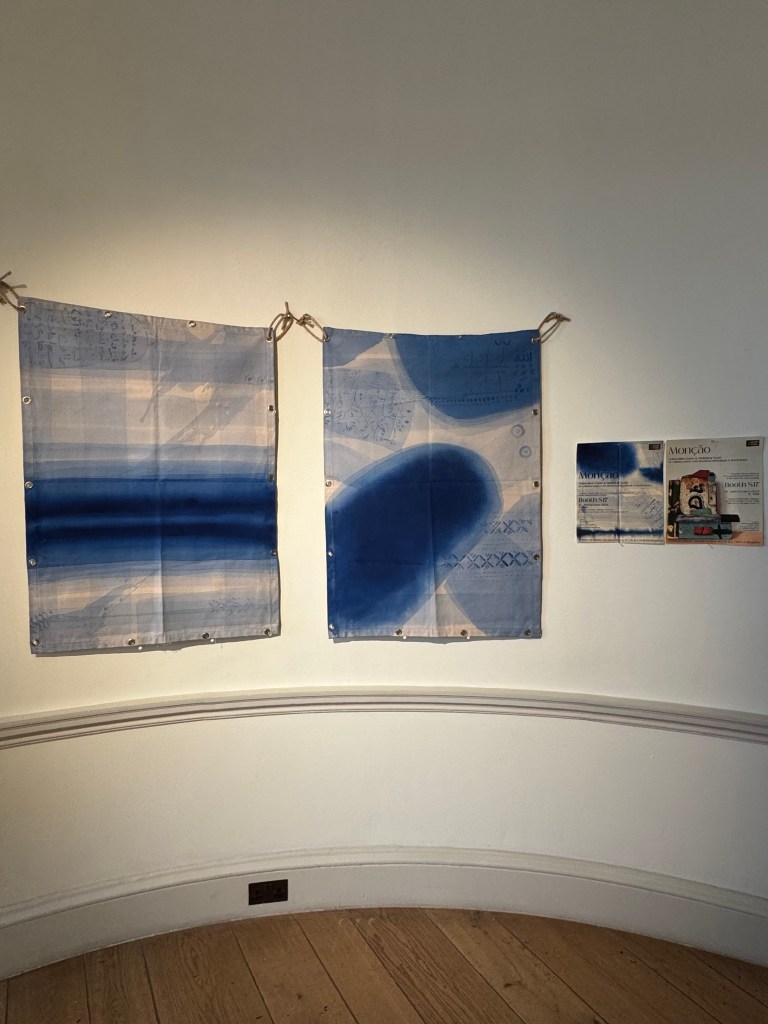
A woman (slightly breathless – she was looking late for something I thought) had come to our booth. That first impression of a visitor is interesting; they might be cursory, almost furtive, or just not interested. Very particularly, she looked as if she needed to be somewhere else as if had to hurry away to face the oncoming week, or some other imminent pressure. She had come around the corner of the adjoining booth almost at a jog. And then in a beat all her movement subsided. She was staring at the paintings.
I said I was happy to answer her questions.
(As a momentary aside – I hate the idea that galleries are silent, formal places where you can’t talk. As if silence is somehow the only meaningful way to look at work, and any other response is uncouth.)
She thanked me, and said she was in a rush, but that, actually, yes, she would love to hear about those. So we spoke. About Mukhtar, and what he paints, and why. She started to cry. Slowly at first, and then more volubly. Neither of us really knew what to do. We hugged.
‘I’m sorry’, she spluttered, ‘it’s just, it’s just that this, this is my England, this is the England I want to be a part of.’
She repeated that a few times, and then added with regret, and nearly, I wondered, with abandon, that she was really very late, and she hastened away. I looked back up at Mukhtar’s canvases, momentarily speechless about that which I had said so much, so often over the last four days.
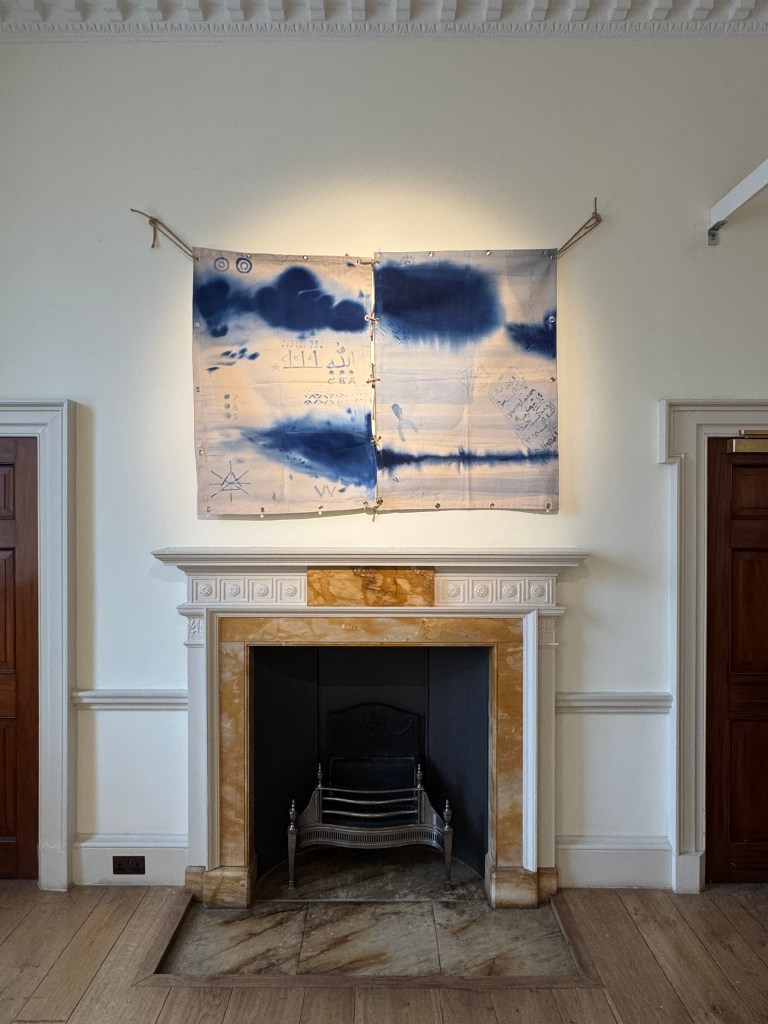
They were as I had left them. But actually that wasn’t true. Because the last time I had looked at them, I hadn’t had the sobbing hug of a stranger. I hadn’t just watched the exchange that had elicited such an immediate pull. And so this time I looked at them from somewhere else, as if I had been given a new resource by…well, I never even got her name. Now I was looking in another way. Such is the quiet miracle of painting.
It was a wet autumnal Sunday blithely hanging on to BST; an Indian gallery at an African fair; an English visitor; an Indian muslim bringing his work to London for the first time. And the hug of two strangers. I haven’t told him yet, perhaps he might read this. But it blew my small and uncomprehending mind.
So it is only fair to say that when I look at them now I do so with that in mind. The context I had given, at a very lively c.1.75x speed for my Sunday rusher, was that Mukhtar is from a family with a deep and extended history of sailing. They sailed people from Mumbai to various parts of Africa; Tanzania, Mozambique etc, through which it is likely the gentle dispersion of Islam took place. He works on sail cloth, these works bordered by the eyelets that help such a connection with the sea, and his colour is indigo. We’d hung them on thick bits of rope. The combination is highly maritime.
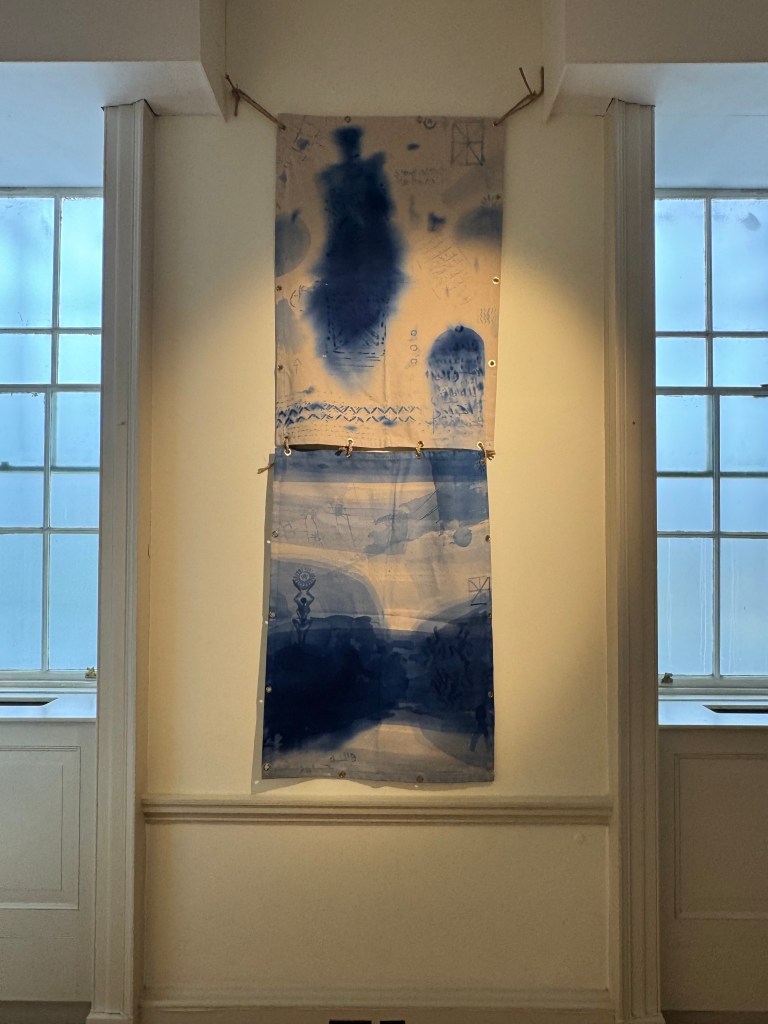
Text has entered his work for the first time here. Quranic verses, inscribed on wooden tablets, shimmy across the plane of the image. On a recent trip to Senegal he had seen young boys learning the Quran. It all felt connected, and so he brought them into his work, along with various guides to pronunciation and esoteric symbols from mystical Islam. Very gentle presences congregate in this pool of ideas and place. It is as if the sea plays host to his family history.
Forty hours wasn’t really enough time.
 G J Varley Art
Leave a comment