Bhupen Khakhar was the opposite of anachronistic – modern? That doesn’t seem to cover it. His paintings are sensuous, brave, graceful, perhaps (aphorisms invited) ahead of their time. Born into a middle-class Gujarati family in Bombay in 1934, he trained as a chartered accountant, and only aged 28 did he start to make art. He seems to tell us that we can all paint. Often his work is anecdotal and autobiographical, and it quickly has that Chagall-like characteristic of being his and his alone.
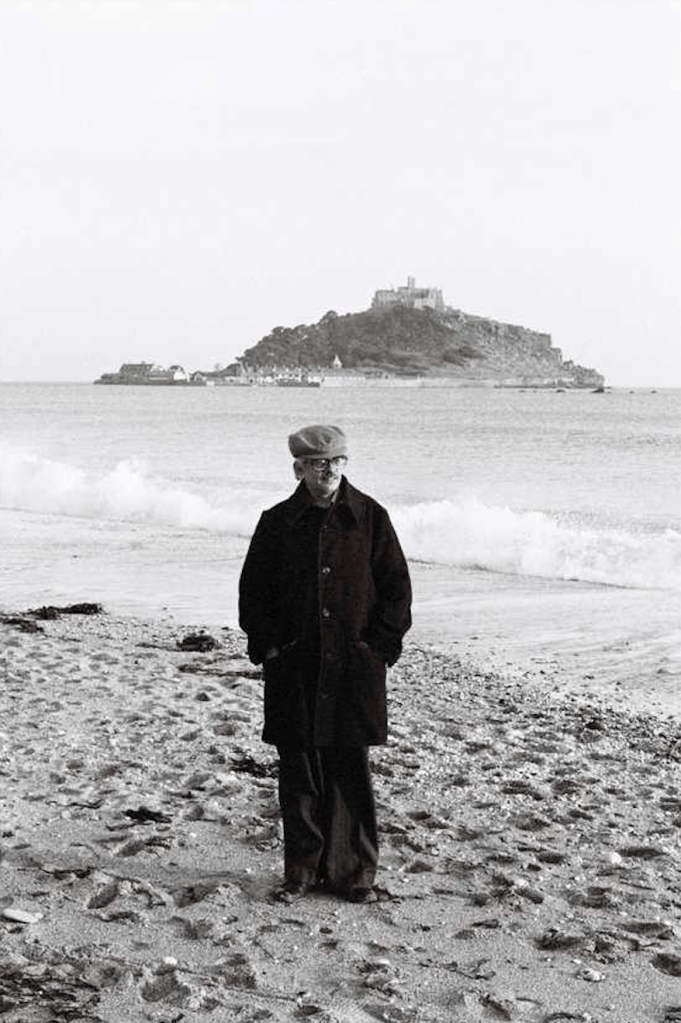
In 1974 he went to the UK; here he is in Cornwall. His time in England saw him get to know David Hockney, and he ended up living with the abstractionist Howard Hodgkin. Britain was fast changing, and it was in England that he witnessed the growing acceptance of homosexuality (legalised in 1967), and after the death of his mother in 1980, his work started to reflect more confidently on his own sexuality.
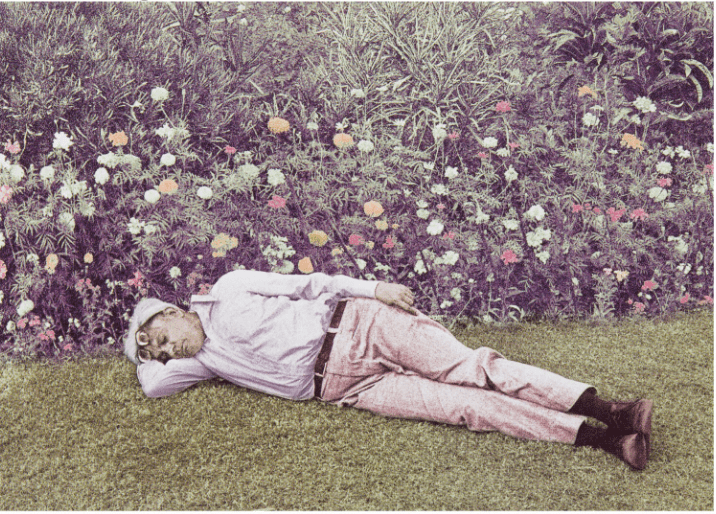
Khakhar having a snooze, courtesy of Tate
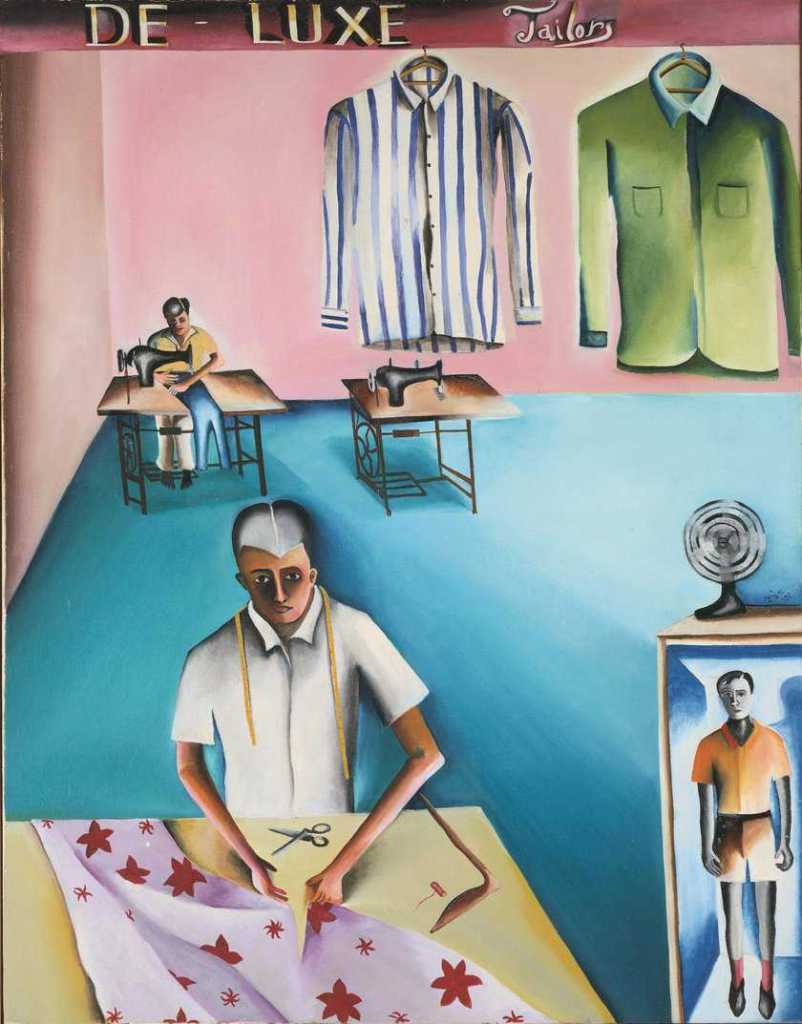
De-Luxe Tailors, 1957, courtesy of Sotheby’s
‘Bhupen’s interest in the ordinary, along with his deep affinity towards the weaker members of society extends to his artistic language.’
Dr Rajeev Lochan, former director of the National Gallery of Modern Art, New Delhi on Krishna Hotel (below)
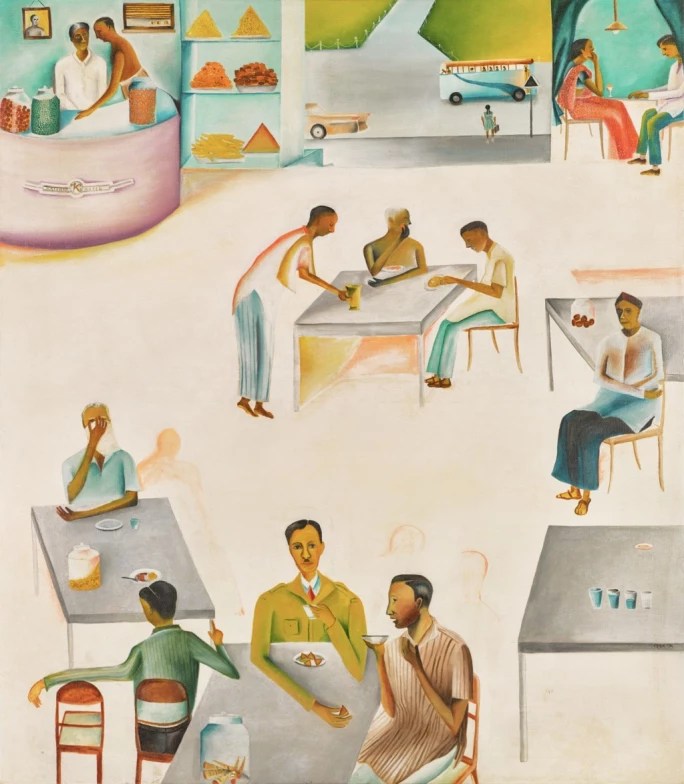
Krishna Hotel, 1972, courtesy of Sotheby’s
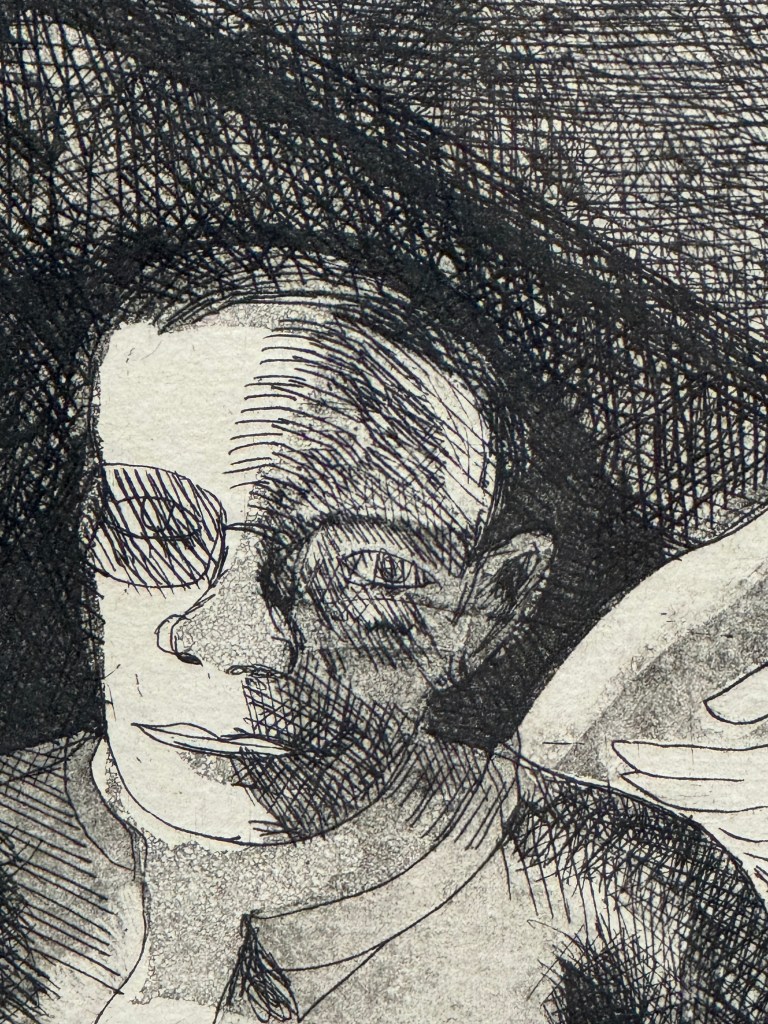
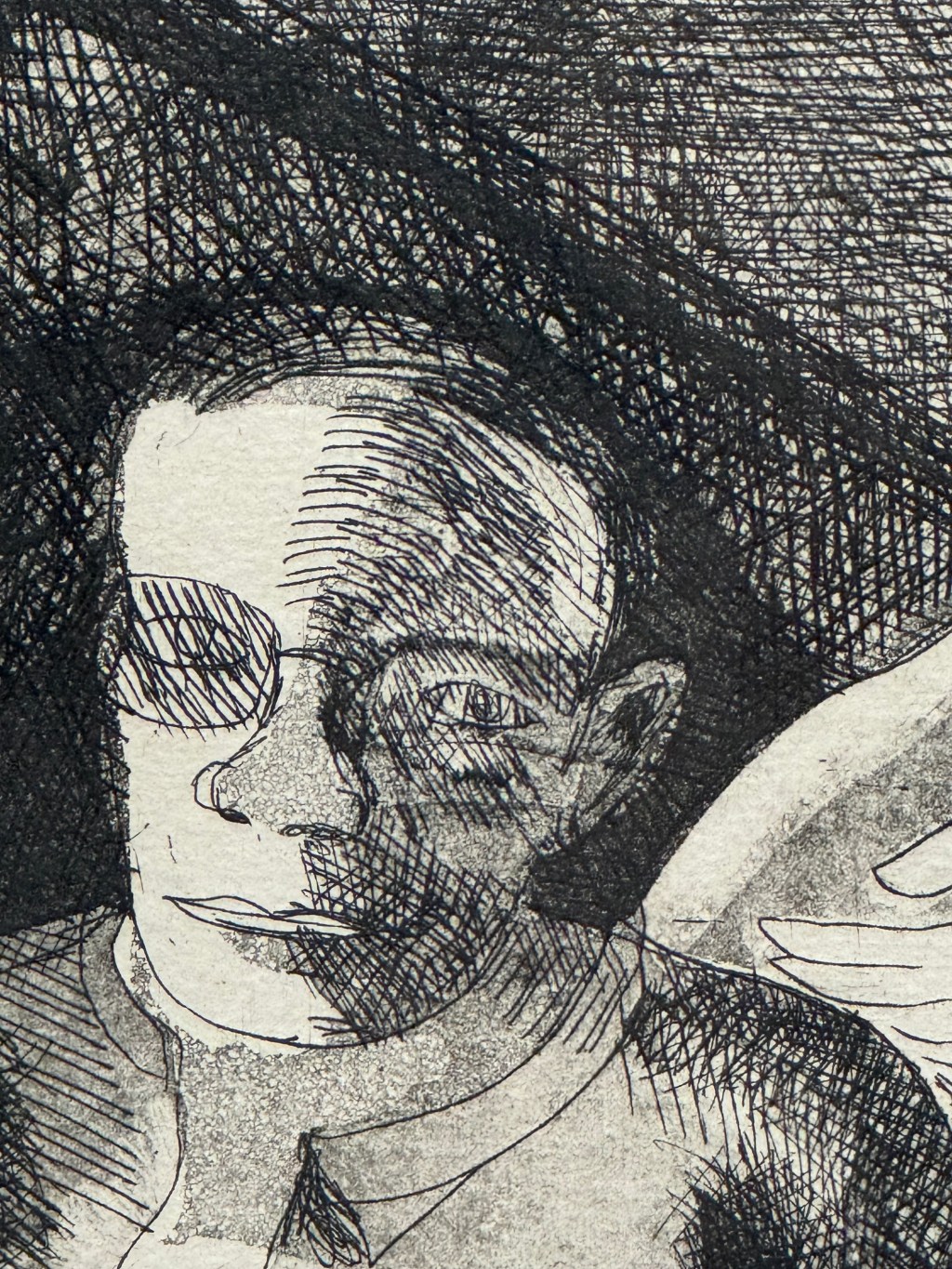
detail from Akara Modern, BHUPEN KHAKHAR: BODY, SHRINE
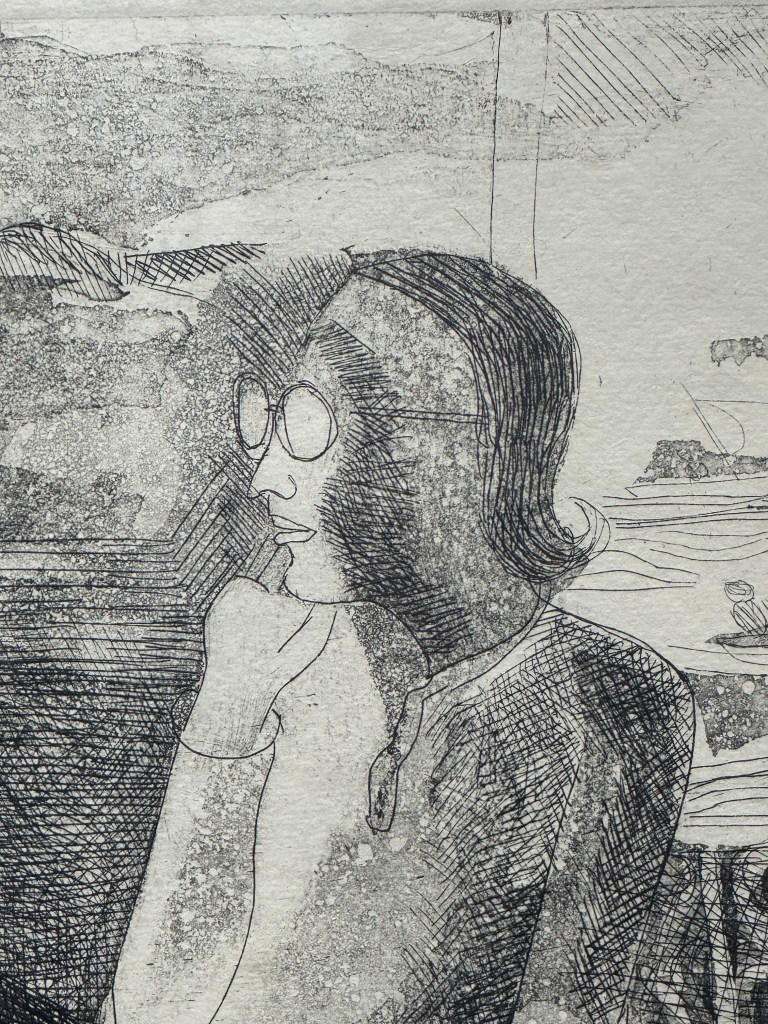
detail from Akara Modern, BHUPEN KHAKHAR: BODY, SHRINE
In many ways this is a hideously grandiose statement, but prior to Two Men in Benares (1982), homosexuality had little trace on the surface of Indian culture. Khakhar would later say of himself ‘I told lies. I did not have the courage to confess that I was going to see and meet my boyfriend.’ Two Men in Benares is an assured painting (one figure is obviously the artist himself). It would be lazy, however, to characterise this scene as gratuitous. Khakhar seems able to present a version of sexuality that sits at a remove from obscenity. The men are obvious, sure, but tender and private, concealed behind a wall or portal of some kind, and connected by the earth that stretches across the painting. Khakhar blamed the British for his nation’s stance towards homosexuality citing ‘our (India’s) Victorian inheritance’. Two Men in Benares is a painting that sensuously strikes back.
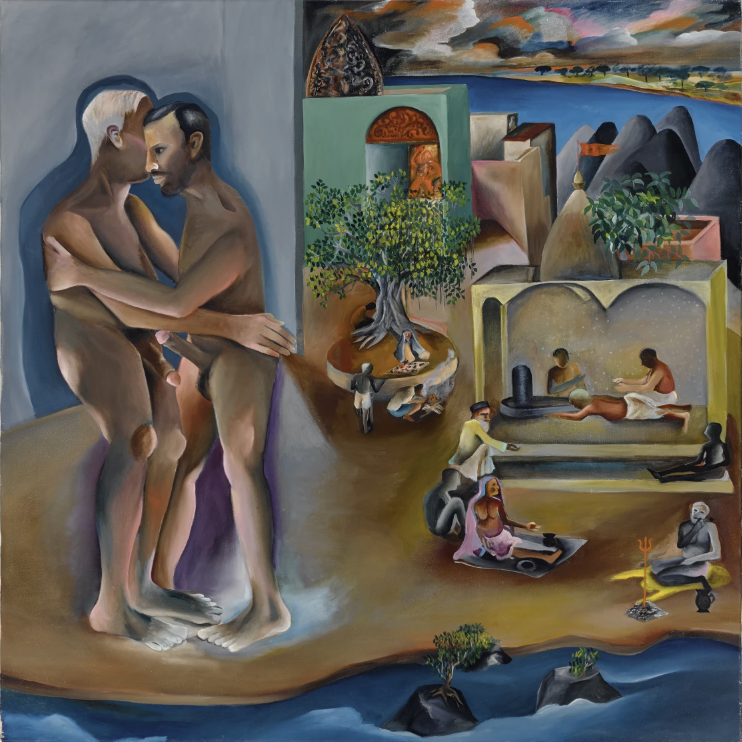
Two Men in Benares, 1982, courtesy of Sotheby’s
Unsurprisingly, it was greeted with excoriating reviews. The gallery rushed to hide it, but the line in the sand had been drawn. Although deeply vernacular in many ways, Khakhar was an international artist. On his trip to Europe he became entranced by Ambrogio Lorenzetti’s frescoes in Siena. There is much in common between how both artists treat background and foreground, as if despite the 600 odd years between them, both are advocates for a pressing attentiveness to the world. Put another way, it is granular detail used widely that offers us an explanation of Lorenzetti’s medieval and Khakhar’s 20th century worlds.
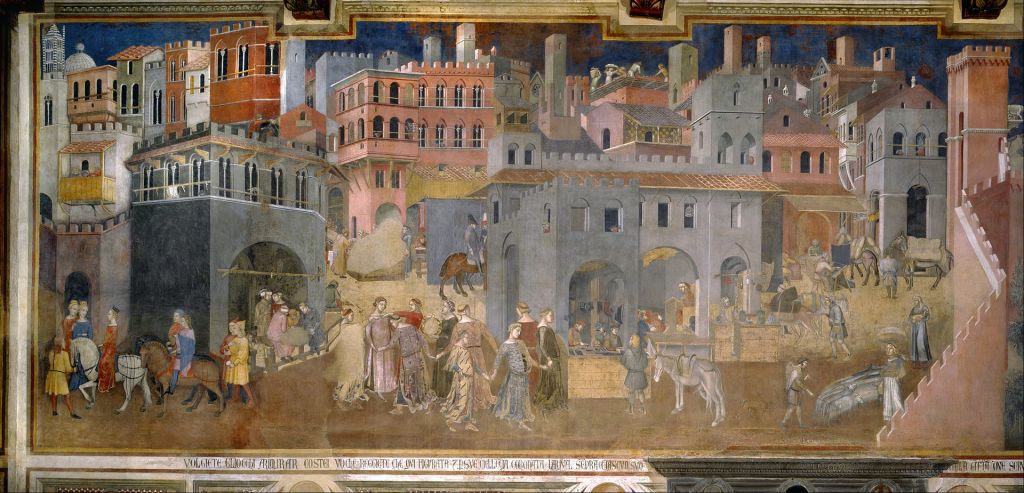
Ambrogio Lorenzetti, The effects of Good Government in the City, 1338-39, courtesy of Google Cultural Institute
Punters (like me) often jump to similarities, like those that can be made between him and David Hockney, but Khakhar said that ‘[he (Hockney) was concerned]…with physical beauty. I am more concerned with other aspects like warmth, pity, vulnerability, touch.’ If you disagree then I suppose you’ll have to take that up with DH. But I’ve included the below as a gentle counterpunch. Hockneyed or not, Khakhar’s work is insistent and important. If you’re in Mumbai, you can catch BHUPEN KHAKHAR: BODY, SHRINE until August 17th.
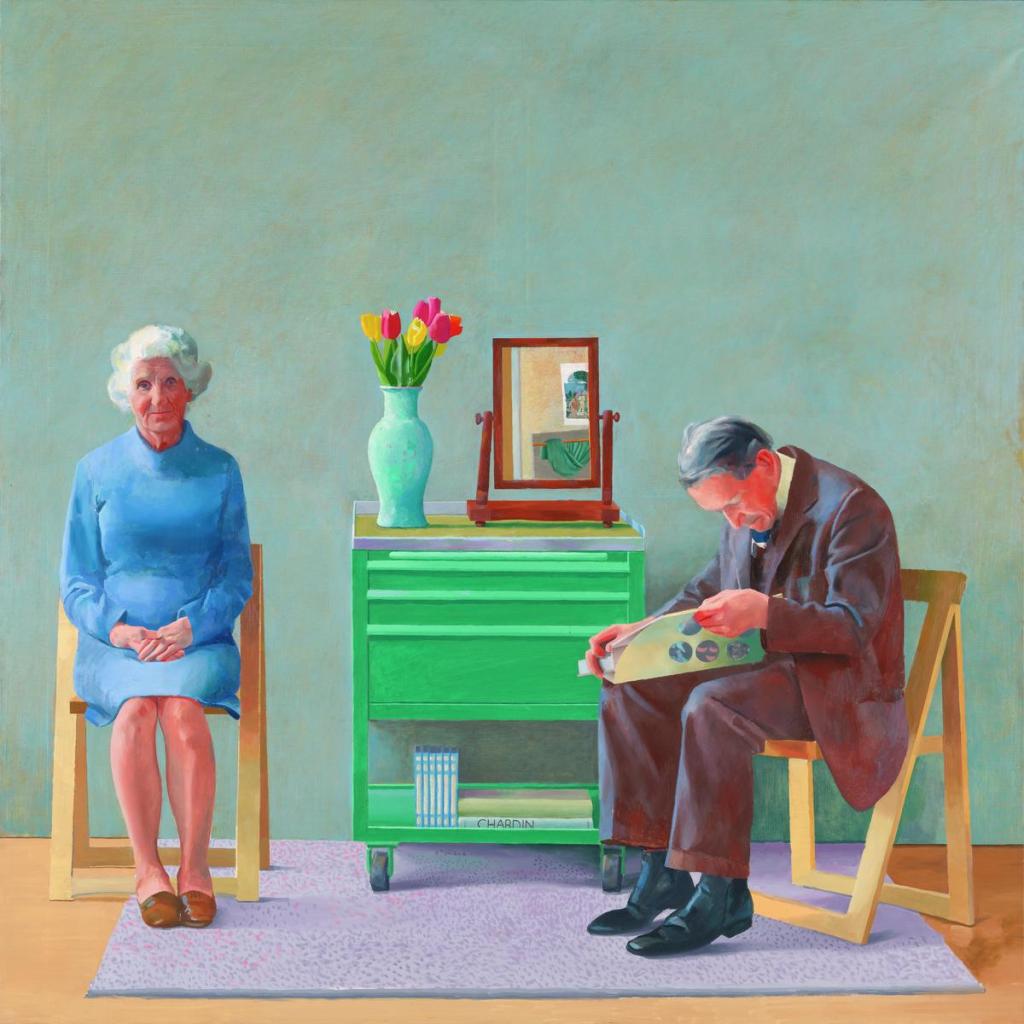
David Hockney, My Parents, 1977, courtesy of Tate


Leave a comment